+44 1753 439 289 michelle@greatbritishtalent.com

The corporate landscape is currently grappling with a quiet, pervasive epidemic. It isn’t the loud, dramatic burnout of the past: it’s the “silent burnout” of 2026. Employees aren't just tired; they are digitally fatigued, overstimulated, and disconnected. Research from Spring Health / Future of Work suggests that around 30% of employees may be experiencing silent burnout: appearing fine on the surface while carrying undetected exhaustion underneath. In a world where 91% of workers report extreme stress, the old model of "work hard, party hard" corporate events is failing.
The traditional loud, high-energy party is no longer the reward it once was. Instead, it’s often just another source of sensory overload. There is also a clear perception gap in many organisations: according to Spring Health / Future of Work, 69% of leaders believe they prioritise mental health, yet only 40% of employees agree. That disconnect matters, especially when events are supposed to rebuild trust, energy, and morale.
We are seeing a profound shift. Events are moving away from mere "entertainment" and toward restoration and mental recharge. The modern executive doesn't want a strobe light; they want a "Corporate Reset." This is where live music transcends its role as a background filler and becomes a strategic tool for well-being: the ultimate antidote to digital fatigue.
The Problem: When "Fun" Becomes a Chore
For years, corporate event entertainment was designed to be loud. The goal was to drown out the stress of the office with high-decibel bands and open bars. But in an era of constant Slack pings and Zoom fatigue, "loud" is no longer the solution. It’s part of the problem.
Digital fatigue + sensory overload = zero ROI on engagement.
When employees attend an event while already operating at a cognitive deficit, a booming sound system doesn't energize them: it shuts them down. They end up huddled in corners, checking their phones, waiting for a socially acceptable time to leave. They aren't reconnecting; they are retreating.
The cost of getting this wrong is not abstract. Disengagement and burnout, often described as “quiet cracking,” are estimated to cost $438 billion in global productivity loss. That makes employee well-being more than a cultural talking point. It is a business issue hiding in plain sight.
The Shift: Moving from Entertainment to Experience Design
At Great British Musicians, we’ve noticed a significant pivot in how forward-thinking organisations approach their gatherings. They are moving from being "entertainment providers" to "experience designers."
Experience design is about intentionality. It’s about asking: How do we want our guests to feel when they walk out of the room?
The Power of Ambient Music for Corporate Networking
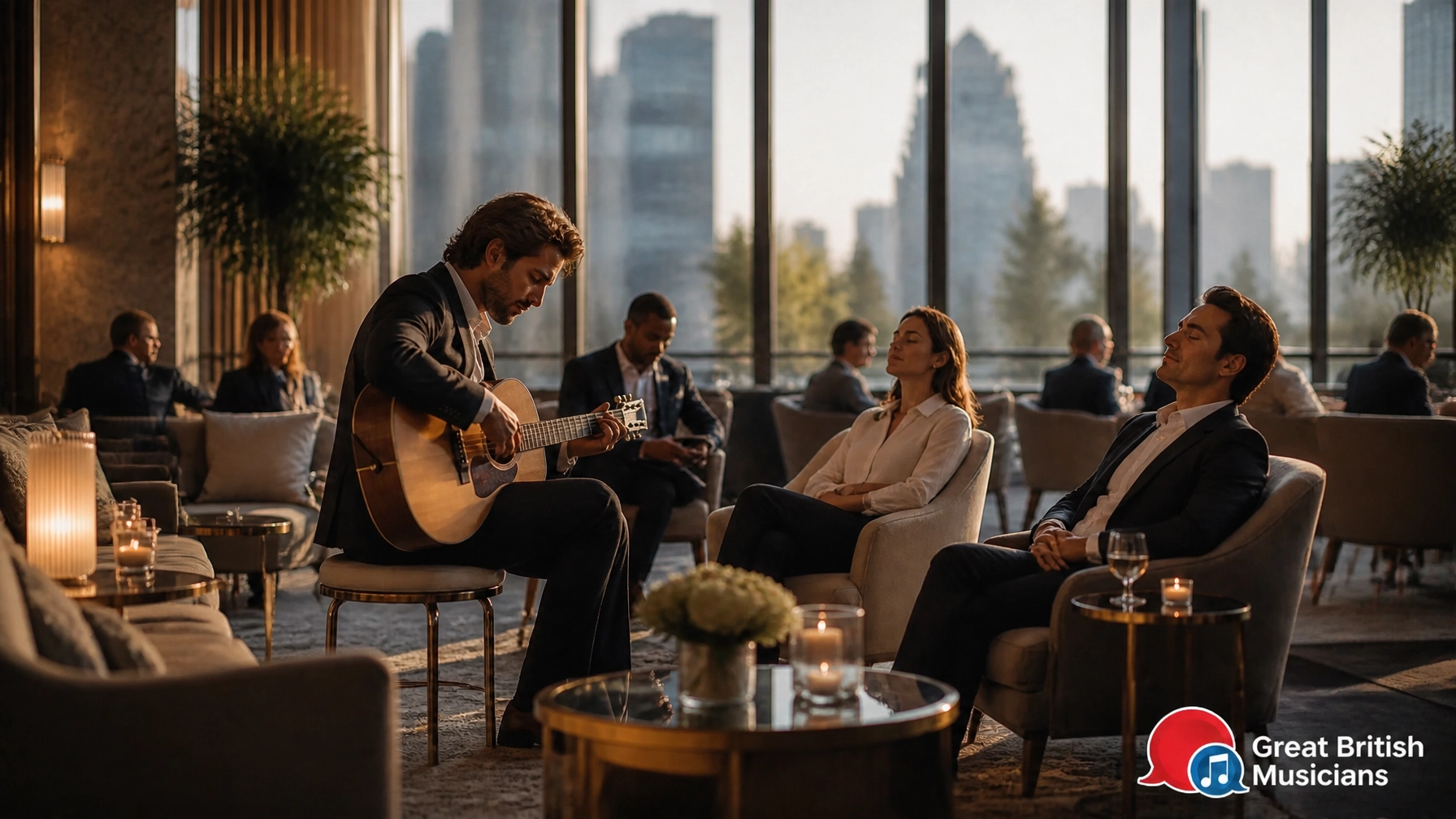
The goal of networking is connection. However, connection is impossible when you have to shout over a DJ. Ambient music for corporate networking: think a sophisticated jazz band hire for corporate events or a solo cellist: creates a "sonic cushion." It fills the silence, providing a sense of privacy for conversations, without demanding the center of attention.
Restorative Sets over High-Energy Hype
We are increasingly curating bespoke corporate entertainment packages that focus on the "slow build." Instead of starting at a level 10, we begin with restorative acoustic sets. This allows guests to physically and mentally transition from their workday "alpha" state into a more relaxed, receptive "theta" state.

The Science of Sound: Why Live Beats Digital
Why does a live acoustic musician for events work better for burnout than a curated Spotify playlist? The answer lies in the human element.
There is also a growing scientific case for live performance in well-being settings. Research published in Frontiers in Psychology shows that live music can significantly lower cortisol levels, in some cases by as much as 50% compared with standard care environments. In plain English: the right music in the right room can help the body shift out of stress mode.
- Vibrational Resonance: Live instruments produce physical sound waves that digital files, even in high fidelity, cannot perfectly replicate. The resonance of a cello or the vibration of a piano string has a tangible, grounding effect on the human nervous system.
- Visual Rhythm: Watching a musician perform: seeing the breath, the movement, and the focus: creates a form of "passive mindfulness." It gives the eyes and mind a singular, beautiful point of focus, breaking the habit of digital scanning.
- The Shared Royalty Pool of Emotion: When a group of people experiences a live performance together, their heart rates often begin to synchronize. This is the "strange loop" of live music; it fosters a sense of communal belonging that a digital interface can never achieve.
Live music + human connection = neurological recovery.
Curation: The Insider Advantage
The difference between a "nice" event and a "transformative" one lies in the curation. You wouldn't trust an algorithm to design your corporate strategy, so why trust one to design your event's atmosphere?
Every artist on our roster is personally vetted by industry veterans Guy Griffin and Michelle Livings. Guy, a 30-year veteran of the music industry who has toured with legends like The Rolling Stones and Bon Jovi, understands the technical mastery required to hold a room. Michelle, a seasoned broadcaster and event host, understands the flow and psychology of high-stakes corporate environments.
Together, they don't just book bands; they curate emotional arcs. They might suggest a performer like Tania de Jong AM, who specialises in the intersection of music and well-being, or an artist like VV Brown for a soulful, sophisticated vibe that demands attention without being intrusive.

The Bottom Line: Music as a Strategic Asset
In 2026, the most successful companies are those that realize their employees' attention and mental health are their most valuable assets. Treating corporate events as a "Corporate Reset" rather than just another party is a competitive advantage.
When you invest in high-quality, curated live music, you aren't just paying for a performance. You are paying for a room full of people who are actually present. You are paying for the moment the phone goes into the pocket and the eyes go to the stage. You are paying for the analogue antidote to a digital world.

At Great British Musicians, we are here to help you design that experience. From soulful jazz to restorative acoustic sets, we provide the insider curation that ensures your next event is a genuine reset, not just another meeting.
Ready to plan your Corporate Reset?
Contact us for a one-to-one consultation and a customised shortlist of vetted artists who specialise in restorative experiences.
Phone: 01753 439 289
Email: michelle@greatbritishtalent.com
Website: www.greatbritishmusicians.com